

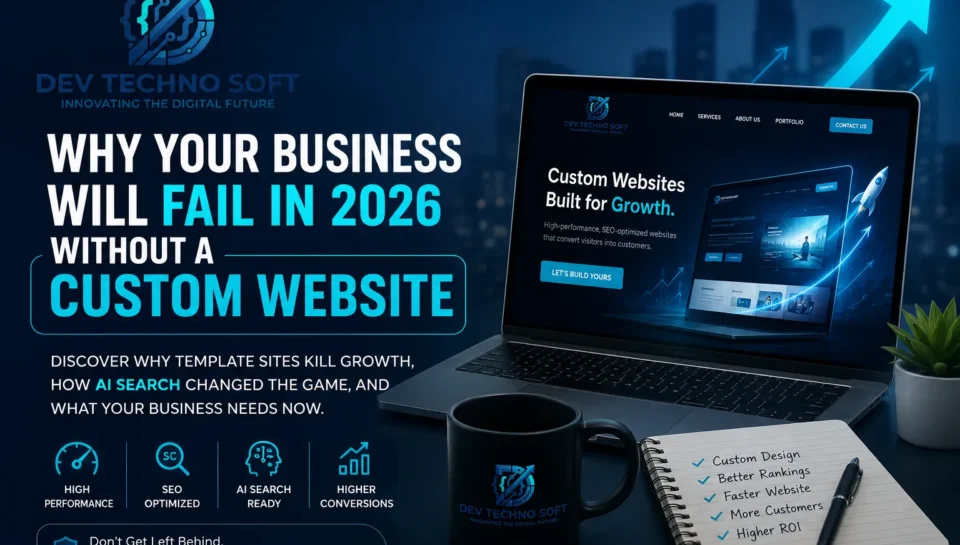
Why Your Business Will Fail in 2026 Without a Custom Website
Let me tell you about a business owner I know, let’s call him Raj.
Raj launched a premium skincare brand in early 2024. He had a fantastic product, genuine five-star reviews, and a small but loyal customer base. But his website? It was a free Wix template with stock photos, a generic colour palette, and a checkout flow that required six clicks to complete a single purchase.
By mid-2025, Raj noticed something alarming. His organic traffic had dropped by 40%. Competitors with inferior products were outranking him on Google. Worse, when people asked ChatGPT or Gemini to recommend Indian skincare brands, Raj’s company was nowhere in the AI-generated responses.
He came to us confused, frustrated, and hemorrhaging revenue.
The diagnosis was straightforward: his website was holding his business hostage.
If this sounds familiar, if your business runs on a template site, a cookie-cutter WordPress theme, or a “good enough” landing page, you need to keep reading. Because in 2026, “good enough” is the same as invisible.
The Digital Landscape Has Fundamentally Changed
Five years ago, having any website was enough to establish credibility. You could throw together a template, stuff a few keywords into your homepage, and Google would reward you with decent rankings.
That era is over.
Here’s what’s different now:
- AI-powered search is mainstream. Google’s AI Overviews, Chat GPT, Gemini, Perplexity, and Claude don’t just crawl your website, they understand They evaluate structure, semantic depth, entity relationships, and whether your content actually answers questions better than competitors.
- Core Web Vitals are non-negotiable. Google’s performance metrics, Largest Content ful Paint (LCP), Interaction to Next Paint (INP), and Cumulative Layout Shift (CLS), directly impact rankings. Template websites, loaded with bloated plugins and unoptimized code, consistently fail these benchmarks.
- Users are ruthless. Studies show 53% of mobile visitors abandon a site that takes longer than three seconds to load. And 75% of consumers judge a company’s credibility by its web design alone.
A generic template cannot keep up with these demands. A custom website, built around your brand, your customers, and your growth goals is the only sustainable path forward.
What Is a Custom Website, Really?
A custom website is a site designed and developed specifically for your business, from the ground up. Unlike templates, which force your brand into a pre-built structure, a custom website is engineered around:
- Your unique customer journey :— guiding visitors from awareness to conversion with intentional design
- Your brand identity :— every color, font, interaction, and layout decision reflects who you are
- Your technical requirements :— integrations with CRMs, payment gateways, analytics dashboards, and third-party APIs
- Your SEO architecture :— clean code, semantic HTML, structured data, and content silos that search engines love
Think of it this way: a template website is a rented apartment. A custom website is a house you own you control the structure, the foundation, and the future.
5 Reasons Template Websites Are Killing Your Business in 2026
1. Template Sites Bleed Performance
Template builders like Wix, Squarespace, and generic WordPress themes come preloaded with features you’ll never use sliders, animations, third-party scripts, and bloated CSS files. This excess code drags down your page speed.
In 2026, Google’s algorithm punishes slow websites aggressively. If your LCP exceeds 2.5 seconds, you’re losing rankings. If your INP is above 200 milliseconds, users feel friction on every click.
Custom websites are built lean. Every line of code serves a purpose. The result? Faster load times, better engagement, and higher search visibility.
2. You Can’t Win AI Search with a Generic Structure
Here’s something most business owners don’t realize: AI search engines evaluate your website’s architecture, not just its content.
When Gemini or ChatGPT generates a response, they prioritize sources with:
- Clear heading hierarchies (H1 → H2 → H3)
- Structured data and schema markup
- Entity-rich content with contextual relationships
- Direct, concise answers to specific questions
Template sites rarely offer granular control over these elements. A custom website lets you engineer every semantic signal making your business more likely to appear in AI Overviews, featured snippets, and conversational search results.
3. Templates Destroy Brand Differentiation
If you’re using the same Shopify theme as 50,000 other stores, how does a customer know you’re different? They don’t.
Your website is often the first touchpoint with a potential customer. A custom design communicates authority, professionalism, and trust signals that both humans and search algorithms value deeply.
This isn’t vanity. E-E-A-T (Experience, Expertise, Authoritativeness, Trustworthiness) is a core ranking factor in 2026. A unique, well-crafted website demonstrates all four pillars.
4. Scalability Hits a Wall
Template websites work until they don’t. The moment you need a custom booking system, a multi-language setup, a membership portal, or an AI-powered product recommendation engine – you hit limitations that require a full rebuild.
Custom websites are architected for growth. New features integrate cleanly. Performance doesn’t degrade as your product catalog or traffic scales. You’re never trapped by someone else’s framework.
5. You Don’t Own Your Digital Presence
Building on a proprietary template platform means renting digital real estate. If the platform changes its pricing, limits your features, or shuts down, your website goes with it.
A custom website gives you full ownership of your code, your data, and your customer relationships. In an age where platforms routinely shift algorithms and terms of service, ownership is survival.
Custom Website vs. Template Website: A Side-by-Side Comparison
| Factor | Custom Website | Template Website |
| Page Speed | Optimized, lean code; consistently passes Core Web Vitals | Bloated with unused scripts; frequent CWV failures |
| SEO Control | Full control over schema, meta tags, heading hierarchy, URL structure | Limited; dependent on platform capabilities |
| AI Search Visibility | Engineered for AI Overviews and conversational search | Rarely structured for AI-driven discovery |
| Brand Identity | Unique, tailored design reflecting your brand | Generic look shared with thousands of other sites |
| Scalability | Built to grow; new features integrate seamlessly | Limited; complex features often require full rebuild |
| Ownership | You own everything – code, data, hosting | Platform-dependent; subject to policy changes |
| Conversion Optimization | Custom funnels, CTAs, and user flows | Restricted by template layout constraints |
| Upfront Cost | Higher initial investment | Lower initial cost |
| Long-Term ROI | Significantly higher over 2–5 years | Often requires expensive rework within 12–18 months |
The AI Search Revolution: Why Your Website Architecture Matters More Than Ever
Let’s talk about a shift that’s caught most businesses off guard.
In 2026, a growing percentage of search queries never reach a traditional results page. Users ask ChatGPT a question and get a direct answer. They use Perplexity to compare services. Google’s own AI Overviews now appear at the top of results for over 30% of informational queries.
If your website isn’t structured for AI engines to understand, you’re invisible to a massive – and growing – audience.
Here’s what AI-ready website architecture looks like:
- Schema markup for your business, services, products, FAQs, and reviews
- Clean heading hierarchy that AI models can parse logically
- Entity-rich content clearly defining what your business does, who it serves, and why it’s authoritative
- FAQ sections with concise, direct answers that AI models can extract verbatim
- Internal linking that creates clear topical clusters and semantic relationships
This isn’t something you bolt onto a template. It requires intentional, expert-level planning exactly the kind of strategic thinking that a professional web development team brings to the table.
Real-World Impact: What Happens When You Invest in a Custom Website
Consider the difference a custom website made for an e-commerce brand we worked with at Dev Techno Soft:
- Page speed improved by 62% after replacing a bloated template with clean, purpose-built code
- Organic traffic increased by 145% over six months, driven by proper SEO architecture and content silos
- Conversion rate doubled thanks to custom checkout flows and strategically placed CTAs
- AI search appearances grew from zero to consistent the brand now shows up in Chat GPT and Gemini responses for their target queries
These results aren’t unusual. They’re what happens when a website is treated as a strategic business asset rather than a decorative afterthought.
How to Know If Your Website Is Holding You Back
Ask yourself these questions honestly:
- Does your website load in under 2.5 seconds on mobile? If not, you’re losing visitors and rankings daily.
- Can you customize your site’s schema markup? If you don’t know what schema markup is, your site probably doesn’t have it.
- Does your website appear in AI-generated search responses? Try searching for your business in Chat GPT or Perplexity. If you’re absent, your architecture needs work.
- Is your site built around conversion funnels? Or does it just display information and hope visitors figure out the next step?
- Can you add complex features without rebuilding? If adding a booking system or a membership area means starting from scratch, your site is a liability.
If you answered “no” to even two of these, your website is actively hurting your business. The good news? This is a solvable problem, and the sooner you address it, the more competitive advantage you gain.
Talk to the Dev Techno Soft team about building a website that actually grows your business.
The Cost of Inaction: What “Waiting” Really Costs You
Every month you operate with an underperforming website, you’re paying an invisible tax:
- Lost organic traffic as competitors with better-optimized sites capture your potential audience
- Lost conversions from visitors who bounce due to slow speeds or confusing navigation
- Lost AI visibility as Chat GPT, Gemini, and Perplexity learn to recommend your competitors instead
- Lost brand equity as customers associate your outdated design with outdated products
The businesses that will dominate their markets in 2026 and beyond aren’t waiting to see what happens. They’re investing in custom, high-performance websites right now, building the digital infrastructure that compounds in value every single month.
Why Dev Techno Soft? A Partner, Not Just a Vendor
At Dev Techno Soft, we don’t just build websites, we engineer digital growth systems. With 9,000+ businesses served, our approach combines:
- Custom web development :— clean code, blazing-fast performance, built around your business logic
- Strategic SEO architecture :— from on-page and technical SEO to content strategy and topical authority building
- AI search optimization :— structured data, semantic content, and entity mapping that positions your brand for the next era of search
- Conversion-focused design :— every element on your site has a purpose, from hero banners to microcopy
- Ongoing performance management :— digital marketing and analytics that keep your growth compounding
We’ve helped startups launch with authority, small businesses scale past their first million, and enterprises modernize their digital presence. If your website isn’t your hardest-working employee, we should talk.
Get a free growth consultation →
Key Takeaways
- A template website is a short-term shortcut with long-term costs
- AI search engines prioritize websites with clean architecture, semantic structure, and entity-rich content
- Core Web Vitals performance directly impacts your rankings and revenue
- Custom websites deliver dramatically better ROI over a 2–5 year horizon
- Brand differentiation, scalability, and data ownership require custom development
The cost of inaction grows every month your competitors aren’t waiting
FAQs
FAQ 1: Why is a custom website important for business in 2026?
A custom website is important because in 2026, search engines and AI platforms evaluate website architecture, speed, and semantic structure not just content. Template websites typically fail Core Web Vitals benchmarks, lack proper schema markup, and can’t be optimized for AI-driven search engines like Chat GPT, Gemini, or Perplexity. A custom website gives you full control over performance, SEO, branding, and conversion optimization all critical for competing in today’s digital landscape.
FAQ 2: What is the difference between a custom website and a template website?
A custom website is designed and coded specifically for your business, with unique layouts, tailored functionality, and clean SEO architecture. A template website uses a pre-built design that’s shared by thousands of other sites, often with bloated code and limited customization options. Custom sites offer better speed, stronger brand identity, superior scalability, and significantly higher long-term ROI.
FAQ 3: How does a custom website improve SEO rankings?
Custom websites improve SEO by giving you full control over heading structure, schema markup, URL architecture, internal linking, page speed, and content organization. You can build proper topical clusters, implement structured data for rich snippets, and ensure your site passes Google’s Core Web Vitals all of which directly influence search rankings. Template websites often restrict these critical optimizations.
FAQ 4: Can a template website rank in AI search engines like Chat GPT?
It’s significantly harder. AI search engines like Chat GPT, Gemini, and Perplexity prioritize websites with clear semantic structure, entity-rich content, and authoritative information architecture. Template websites rarely provide the granular control needed to optimize for these AI signals. Custom-built websites, with intentional schema markup and content hierarchy, are far more likely to appear in AI-generated answers.
FAQ 5: How much does a custom website cost compared to a template?
A custom website typically costs more upfront, ranging from a few thousand to tens of thousands depending on complexity. However, the long-term ROI is substantially higher. Template websites often require expensive rework within 12–18 months as businesses outgrow their limitations. When you factor in lost traffic, lower conversion rates, and rebuilding costs, a custom website is almost always the more cost-effective choice over a 2–5 year period.
FAQ 6: What are Core Web Vitals and why do they matter for my website?
Core Web Vitals are Google’s performance metrics that measure loading speed (LCP), interactivity (INP), and visual stability (CLS). They directly affect your search rankings and user experience. In 2026, websites that fail Core Web Vitals benchmarks are penalized in search results and are rarely featured in AI-generated search overviews. Custom websites, built with optimized code, consistently outperform template sites on these critical metrics.
FAQ 7: Is a custom website necessary for small businesses?
Yes. Small businesses often compete against larger brands with more resources. A custom website levels the playing field by providing superior local SEO, faster performance, a unique brand presence, and conversion-optimized design, all of which help small businesses capture market share from bigger competitors relying on generic solutions. It’s one of the highest-ROI investments a small business can make.
FAQ 8: How long does it take to build a custom website?
A typical custom website takes 4 to 12 weeks to build, depending on complexity, number of pages, integrations, and design requirements. While this is longer than launching a template site, the result is a high-performance digital asset that drives measurable business growth, not a stopgap that needs replacing in a year.