

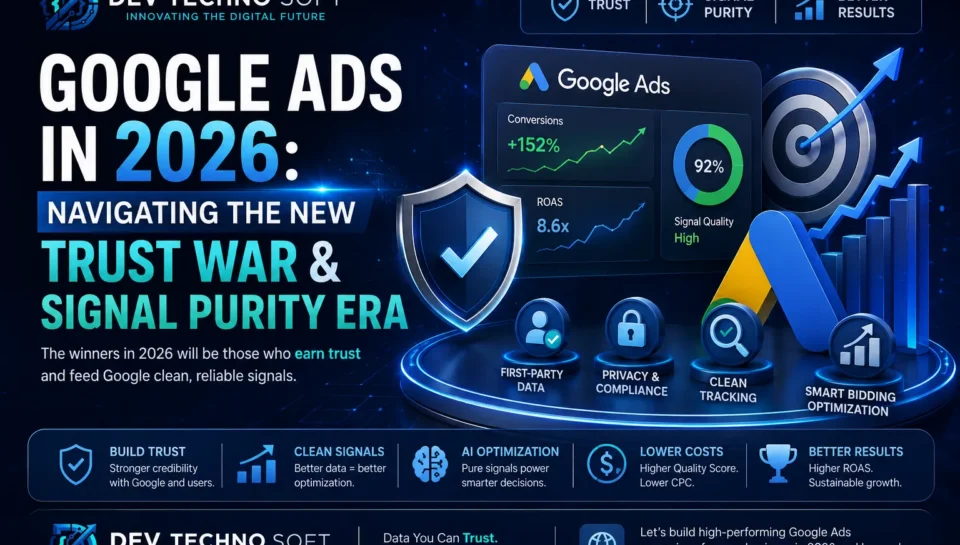
Google Ads in 2026: Navigating the New Trust War & Signal Purity Era
The Rules Have Changed — And Most Advertisers Haven’t Noticed
A year ago, you could get away with sloppy conversion tracking. You could throw a handful of broad match keywords into a Performance Max campaign, set a target ROAS, and let Google’s machine do the rest. It wasn’t elegant, but it worked often enough.
That era is over.
Google Ads in 2026 operates on a fundamentally different set of rules. The platform hasn’t just added new features — it has restructured the relationship between advertiser and algorithm. And at the center of this restructuring are two forces that will define who wins and who bleeds budget for the next several years: trust and signal purity.
Here’s the uncomfortable truth: Google no longer just evaluates your bids. It evaluates you. Your data hygiene, your consent infrastructure, your landing page integrity, your conversion signal accuracy — all of it feeds into how the algorithm treats your campaigns. Advertisers who understand this are seeing lower CPCs, stronger ROAS, and sustainable growth. Those who don’t are watching their performance slowly erode without understanding why.
This isn’t a minor platform update. It’s a paradigm shift. And in this guide, we’re going to break down exactly what’s happening, why it matters, and how to position your campaigns on the right side of it.
Quick Definition: Signal purity in Google Ads refers to the quality, accuracy, and reliability of the data you feed into Google’s AI-powered bidding and targeting systems. Clean signals produce high-quality optimization; polluted signals cause algorithm drift — a gradual deterioration in campaign performance as the AI chases the wrong outcomes.
What Is the “Trust War” in Google Ads?
The trust war isn’t a marketing buzzword. It’s the practical reality of how Google now evaluates advertisers — and it goes far beyond whether your ads comply with editorial policies.
Advertiser Verification Is No Longer Optional
Google’s Advertiser Verification Program has evolved into a multi-layered system that scrutinizes the identity, legitimacy, and operational transparency of every entity running ads on the platform. Once verified, your business name and location are publicly visible in the Ads Transparency Center. Failure to complete verification results in paused ads or full account suspension.
But verification alone isn’t the whole picture. Google now quietly evaluates a constellation of trust indicators that influence how your campaigns perform in the auction:
- Landing page transparency — Clear contact information, privacy policies, accessible terms of service
- E-E-A-T alignment — Signals of Experience, Expertise, Authoritativeness, and Trustworthiness on your destination pages
- User experience metrics — Page speed, mobile responsiveness, bounce rate, and time-on-site as “silent” trust signals
- Brand consistency — Matching business information across Google Business Profile, ad copy, and landing pages
- Social proof — Genuine reviews, testimonials, and third-party endorsements that validate your credibility
Think of it this way: Google’s AI is no longer just deciding where to place your ads. It’s deciding how much to trust you — and that trust level directly impacts your Ad Rank, your CPC, and your campaign ceiling.
For businesses running paid campaigns through an experienced digital marketing agency, this trust infrastructure should already be in place. For those managing campaigns in-house, it’s the single most overlooked competitive lever in Google Ads right now.
Signal Purity: The Concept That Will Define PPC Winners in 2026
If trust is the foundation, signal purity is the fuel. And right now, most advertisers are running on contaminated fuel without realizing it.
What Signal Purity Actually Means
Every piece of data you send to Google Ads — every conversion event, every audience signal, every customer match list — teaches the algorithm what to optimize for. Signal purity is the measure of how clean, accurate, and genuinely representative that data is.
When your signals are pure, the AI learns correctly. It identifies high-value users, targets similar prospects, and allocates budget toward outcomes that actually grow your business.
When your signals are polluted? The AI still learns — but it learns the wrong lessons.
The Three Types of Signal Pollution
| Pollution Type | What It Looks Like | Business Impact |
| Soft Conversion Inflation | Counting page views, button clicks, or scroll depth as “conversions” | AI optimizes for low-intent actions; real conversion volume drops |
| Junk Lead Contamination | Bot-filled forms, test submissions, or unqualified leads entering your pipeline | Algorithm chases easy, worthless leads; CPA rises while lead quality collapses |
| Audience Signal Dilution | Mixing high-intent and low-intent products or audiences in the same campaign | Bidding algorithm can’t distinguish value; budget shifts toward low-value segments |
Every one of these problems is invisible at the surface level. Your dashboard might show stable or even improving conversion volume. But the quality of those conversions is degrading — and the algorithm is drifting further from your actual business goals with every optimization cycle.
This phenomenon is called algorithm drift, and it’s the silent killer of Google Ads performance in 2026.
Expert Insight: Algorithm drift rarely announces itself with a performance crash. Instead, it manifests as a slow shift — slightly worse lead quality this month, a subtle change in the types of search queries winning auctions, margins gradually thinning. By the time most advertisers notice, the AI has been training on polluted data for weeks.
The Consent Mode v2 Deadline: What Changed on June 15, 2026
One of the most consequential changes this year happened quietly. On June 15, 2026, Google removed the ability to use GA4’s “Google Signals” toggle as a data control mechanism. The implications are massive — and many advertisers still haven’t adapted.
What This Means in Practice
Consent Mode is now the exclusive control center for Google Ads data. If your Consent Management Platform (CMP) grants ad_storage, Google will process user data and link it to signed-in Google profiles — regardless of any previous GA4 settings.
Here’s the critical breakdown:
- ad_storage — Controls whether advertising cookies can be set
- analytics_storage — Controls whether analytics cookies can be set
- ad_user_data — Controls whether user data can be sent to Google for advertising purposes
- ad_personalization — Controls whether remarketing and personalized advertising is allowed
If your consent banner isn’t correctly configured to pass all four signals, you’re operating blind. Google’s AI can’t model conversions it can’t see, and your Smart Bidding strategies will underperform — sometimes catastrophically.
Advanced vs. Basic Consent Mode
| Mode | How It Works | Impact on Performance |
| Advanced Consent Mode | Tags load on every page. When consent is denied, cookieless “pings” are sent, allowing Google’s AI to model missing data | Maintains strong signal coverage; recommended for all advertisers |
| Basic Consent Mode | Tags are completely blocked until explicit consent is given | Creates significant data gaps; cripples AI modeling capability |
The bottom line: If you’re running Basic Consent Mode, you’re giving Google’s AI an incomplete picture of your customers — and it’s making bidding decisions based on that incomplete picture. Switching to Advanced Consent Mode is one of the highest-impact, lowest-effort changes you can make right now.
First-Party Data: From Nice-to-Have to Non-Negotiable
With third-party cookies effectively dead and tracking fragmentation at an all-time high, first-party data isn’t a competitive advantage anymore. It’s table stakes.
Enhanced Conversions: The Accuracy Layer
Enhanced Conversions have been unified in 2026 — Web and Leads are now a single streamlined feature. When a user converts on your site, hashed first-party data (email, phone number) is sent to Google to match that conversion to a signed-in user, even when cookies are unavailable.
The result? More accurate attribution, better Smart Bidding training data, and fewer “dark” conversions that your algorithm can’t learn from.
Your coverage rate — the percentage of conversions matched with first-party data — is now the single most important diagnostic metric in your account. Industry benchmarks suggest that accounts consistently maintaining coverage rates above 70% see meaningfully better bidding performance compared to those below that threshold.
Customer Match and Audience Signals
Your CRM data is the most powerful steering mechanism you have for Google’s AI:
- High-LTV customer lists teach the algorithm what your best customers look like
- Recent purchaser exclusions prevent budget waste on people who already converted
- Lead qualification data (imported from Salesforce, HubSpot, or any CRM) tells Google which leads were actually valuable — so it stops chasing junk
- Data Manager API — centralized in 2026 — consolidates your data pipelines and improves matching accuracy
The advertisers winning in this environment aren’t the ones with the biggest budgets. They’re the ones with the cleanest data pipelines and the most disciplined signal architecture.
Working with a team that understands both paid advertising management and the technical infrastructure behind conversion tracking makes a measurable difference in campaign performance.
Performance Max in the Signal Purity Era
Performance Max remains Google’s flagship campaign type — and its biggest black box. In 2026, PMax performance is almost entirely determined by the quality of what you feed it.
The PMax Signal Purity Playbook
- Prioritize hard conversions over vanity metrics
Remove soft goals (page views, scroll events, time-on-site) from your conversion actions. Feed PMax only the events that represent genuine business value — purchases, qualified lead submissions, booked calls.
- Import offline conversion data
Connect your CRM and import lead qualification outcomes. When PMax knows that Lead A became a $10,000 customer while Lead B never responded, it fundamentally changes how the algorithm targets future prospects.
- Use brand exclusions aggressively
Without explicit brand exclusions, PMax will default to capturing branded search traffic — inflating ROAS metrics while delivering zero incremental growth. Force the algorithm to find new demand by excluding your brand terms at the campaign level.
- Shift to profit-based bidding
Stop optimizing for revenue. Calculate your target based on gross profit margin and feed those values as your conversion value. This trains the machine to chase profitable customers, not just high-revenue ones.
- Rotate creative assets frequently
Creative fatigue is a signal purity problem. When the same assets run for months, declining engagement rates corrupt the algorithm’s performance model. Treat creative refresh as a data hygiene practice, not just a branding exercise.
Actionable Takeaway: Schedule a monthly “signal audit” — review your conversion actions, check for spam leads in your CRM data, verify your consent implementation, and refresh stale creative assets. This single habit prevents the gradual signal decay that undermines most Google Ads accounts.
Landing Page Trust: The Forgotten Quality Score Lever
Here’s something most advertisers overlook: your landing page isn’t just a destination for clicks. In 2026, it’s an active participant in how Google evaluates your ads.
Google’s AI now uses post-click behavior — bounce rates, engagement depth, conversion follow-through — as real-time feedback on whether your ad delivered on its promise. Landing pages that create friction, confusion, or mistrust don’t just lose conversions. They actively damage your Ad Rank.
What Google’s Algorithm Looks for on Your Landing Pages
- Intent alignment — Does the page deliver exactly what the ad promised? Generic homepages kill relevance scores.
- Page speed — Mobile load times under 2.5 seconds are baseline. Every additional second measurably erodes conversion rates.
- Transparent trust signals — Visible reviews, security badges, clear pricing, accessible contact information
- Content depth — Thin or auto-generated content triggers lower experience scores
- Mobile-first design — Majority of ad clicks come from mobile; desktop-only optimization is no longer viable
For e-commerce brands and service businesses alike, landing page quality has become inseparable from campaign quality. An ad account managed by professionals who understand both campaign strategy and web development will consistently outperform accounts where these disciplines operate in silos.
The 2026 Google Ads Survival Checklist
If you take nothing else from this article, implement these seven priorities:
- Audit your Consent Mode implementation — Ensure your CMP passes all four required signals and that Advanced Consent Mode is active
- Clean your conversion actions — Remove soft goals; keep only events that represent real business value
- Enable Enhanced Conversions — Verify that hashed first-party data is being captured at the point of conversion
- Import offline conversion data — Connect your CRM to close the loop between ad clicks and actual business outcomes
- Monitor your coverage rate — Target 70%+ consistently; this is your campaign health indicator
- Audit landing page trust signals — Speed, transparency, intent alignment, mobile UX, and social proof
- Schedule monthly signal audits — Prevent algorithm drift through systematic data hygiene
Key Takeaways
- Google Ads in 2026 is a trust-and-signal game. The platform evaluates your credibility, data quality, and user experience — not just your bid.
- Signal purity determines AI performance. Polluted data causes algorithm drift that silently erodes campaign results over weeks and months.
- Consent Mode v2 is now the sole data control. Misconfigured consent infrastructure means your AI is making decisions on incomplete information.
- First-party data is non-negotiable. Enhanced Conversions, Customer Match, and offline data imports are the foundation of competitive performance.
- Landing pages are active auction participants. Post-click behavior directly influences your Ad Rank and CPC.
- Monthly signal audits prevent decay. The highest-performing accounts treat data hygiene as an ongoing discipline, not a one-time setup.
Frequently Asked Questions (FAQs)
What is signal purity in Google Ads?
Signal purity refers to the quality and accuracy of the data you feed into Google’s AI-powered bidding and targeting systems. Clean, high-quality signals — such as verified conversions, qualified leads, and accurate customer data — help the algorithm optimize toward genuine business outcomes. Polluted signals — like bot submissions, soft conversions, or mixed audience data — cause the AI to optimize in the wrong direction, leading to algorithm drift and declining performance.
What is algorithm drift in Google Ads?
Algorithm drift is the gradual deterioration of campaign performance that occurs when Google’s AI trains on polluted or misleading data. It typically manifests as slowly declining lead quality, subtle shifts in which search queries win auctions, or thinning margins — rather than a sudden performance crash. By the time most advertisers notice, the AI has been learning from bad data for weeks.
What changed with Consent Mode on June 15, 2026?
Google removed the ability to use GA4’s “Google Signals” toggle as a data control mechanism. Consent Mode is now the exclusive control center for Google Ads data. If your Consent Management Platform grants ad_storage, Google will process user data and link it to signed-in profiles regardless of any previous GA4 settings. This makes correct CMP configuration critical for campaign performance.
Should I use Advanced or Basic Consent Mode?
Advanced Consent Mode is strongly recommended for all advertisers. It loads tags on every page and sends cookieless pings when consent is denied, allowing Google’s AI to model missing conversion data. Basic Consent Mode blocks all tags until explicit consent is given, creating significant data gaps that cripple Smart Bidding performance.
How does first-party data improve Google Ads performance in 2026?
First-party data — collected directly from your customers through purchases, form submissions, and CRM interactions — provides Google’s AI with verified, high-quality signals about who your real customers are. Through Enhanced Conversions, Customer Match, and offline data imports, this data teaches the algorithm to identify and target users who resemble your most valuable customers, improving both targeting precision and bidding accuracy.
What coverage rate should I target for Enhanced Conversions?
Industry benchmarks suggest that maintaining a coverage rate consistently above 70% correlates with meaningfully better Smart Bidding performance. Coverage rate measures the percentage of your conversions that are successfully matched with first-party data. You can monitor this metric in the Google Ads diagnostics dashboard.
How do I prevent signal pollution in Performance Max campaigns?
Focus on three priorities: (1) Remove soft conversion goals — only track events that represent genuine business value like purchases or qualified leads. (2) Import offline conversion data from your CRM so the algorithm learns which leads actually converted into customers. (3) Use brand exclusions to prevent PMax from defaulting to branded traffic, which inflates ROAS without driving incremental growth.
Does landing page quality still affect Google Ads performance in 2026?
Absolutely — and more than ever. Google’s AI now uses post-click engagement signals like bounce rate, time-on-page, and conversion follow-through to evaluate whether your ad delivered on its promise. Landing pages with slow load times, poor mobile experience, or misaligned messaging actively damage your Ad Rank and increase your CPC. Treating your landing page as an integrated part of your campaign — not a separate website concern — is essential for competitive performance.