


If you are an SEO professional, digital marketer, or business owner, you already know the truth: doing the SEO work is only half the battle. The other half is proving that your work is actually driving results.
Whether you are presenting to C-suite executives, updating stakeholders, or justifying your retainer to clients, your SEO report is your ultimate source of truth. However, building comprehensive, professional, and actionable SEO reports can quickly become expensive if you are paying for premium software suites.The good news? You don’t have to drain your budget to create world-class reporting. At Dev Techno Soft, we believe in leveraging smart, accessible technology. In this guide, we are going to break down the top 5 free SEO tools for building better SEO reports, exploring exactly how to use them to track key metrics, visualize data, and demonstrate undeniable ROI.
Why Accurate SEO Reporting is Critical in 2026
Before diving into the tools, it is crucial to understand why we report. A standard data dump of spreadsheets will no longer cut it. Modern SEO reporting must tell a story.
- Proves ROI and Value: Stakeholders want to see how organic traffic translates into revenue. Good reporting connects keyword rankings to actual business growth.
- Drives Data-Backed Decisions: By analyzing what is working and what is falling flat, you can pivot your SEO strategy with precision rather than guessing.
- Builds Client Trust: Transparency is the currency of digital marketing. Clear, easy-to-understand reports build long-term trust and reduce client churn.
To achieve this, you need a tech stack that captures accurate data, analyzes technical health, and visualizes the results beautifully. Let’s look at the free tools that make this possible.
1. Looker Studio (Formerly Google Data Studio)
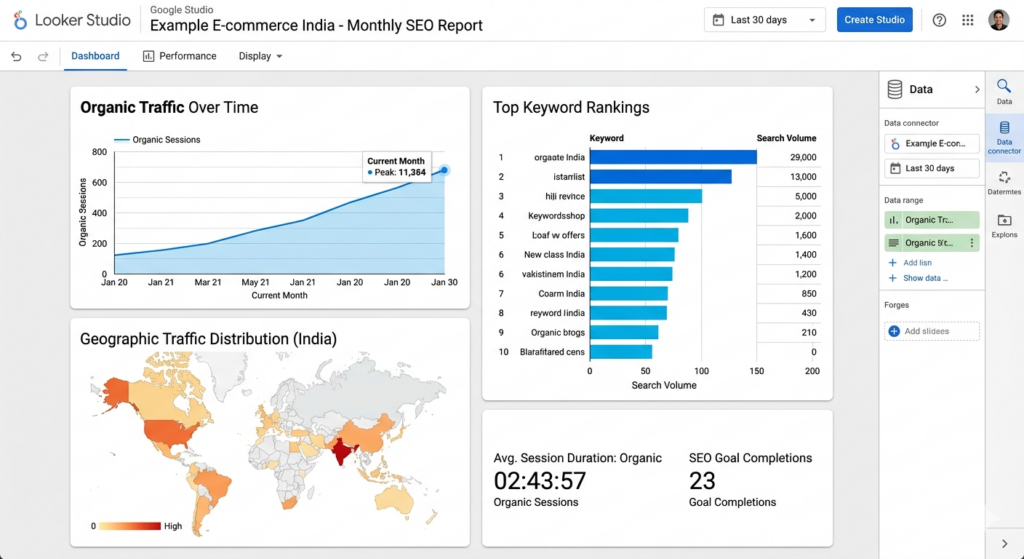
When it comes to actually building the report, Looker Studio is the undisputed king of free software. It is not a data source itself; rather, it is a powerful visualization tool that pulls data from multiple sources into one cohesive, interactive dashboard.
Why It Is Essential for SEO Reporting
Looker Studio allows you to step away from static PDFs and confusing Excel sheets. You can build dynamic reports where clients can adjust date ranges, filter by campaigns, and interact with the data in real-time.
- Seamless Integration: It natively connects with Google Analytics, Google Search Console, Google Ads, and YouTube Analytics with zero coding required.
- White-Labeling: You can fully customize the dashboard with your brand colors, fonts, and logos (or your client’s branding).
- Calculated Metrics: You can create custom formulas to show specific conversion rates or combine data streams for advanced insights.
Expert Actionable Tip
Don’t build from scratch if you don’t have to. Search for “Free Looker Studio SEO Templates” online. You can copy a professional template, connect your own data sources, and have a highly advanced SEO report ready in less than 10 minutes.
2. Google Search Console (GSC)
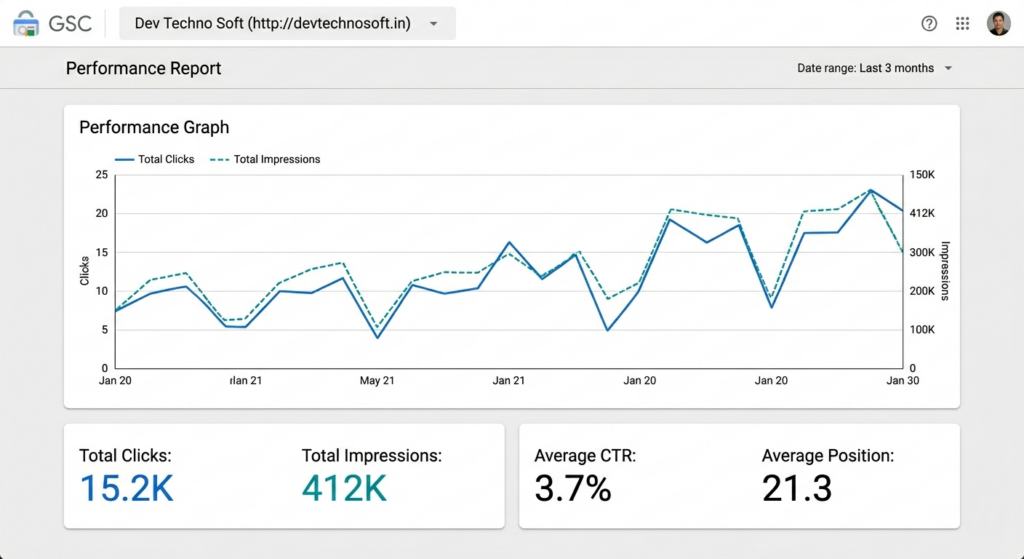
Google Search Console is the closest thing you will ever get to a cheat code in SEO. It provides direct, unfiltered data straight from Google regarding how your website is performing in the search engine results pages (SERPs). Any SEO report that does not include GSC data is fundamentally incomplete.
Why It Is Essential for SEO Reporting
While Google Analytics tells you what users do after they land on your site, GSC tells you what they were doing before they clicked.
- Keyword Performance: Track exactly which search queries are driving impressions and clicks to your pages.
- Click-Through Rate (CTR): Identify pages that rank high but have low clicks, giving you immediate targets for meta-title and description optimization.
- Indexing Health: Show clients that their newly published content is being successfully crawled and indexed by Google.
Expert Actionable Tip
Use GSC to find “Low-Hanging Fruit” keywords. Filter your performance report to show queries ranking in positions 11-20. Include these in your SEO report as “Target Opportunities.” A slight optimization to the pages ranking for these terms can easily push them onto page one, creating a quick win for your clients.
3. Google Analytics 4 (GA4)
The transition to Google Analytics 4 shifted the focus from session-based tracking to event-based tracking. For SEO reporting, GA4 is your primary tool for proving that the organic traffic you are generating is actually valuable.
Why It Is Essential for SEO Reporting
Traffic without engagement is a vanity metric. GA4 helps you report on the actual behavior and profitability of your organic visitors.
- Traffic Acquisition: Clearly separate organic search traffic from direct, social, and referral traffic to isolate the impact of your SEO efforts.
- Engagement Rate: Replace the outdated “bounce rate” with engagement rate, showing stakeholders that users are actively reading content and interacting with the site.
- Conversion Tracking: Tie organic traffic directly to form submissions, phone calls, e-commerce purchases, or newsletter signups.
Expert Actionable Tip
In your report, don’t just show total organic traffic. Create a segment in GA4 for “Organic Traffic to Blog Posts” versus “Organic Traffic to Service/Product Pages.” This helps clients understand top-of-funnel brand awareness versus bottom-of-funnel conversions.
4. Ahrefs Webmaster Tools (AWT)
While Ahrefs is known as a premium, expensive enterprise tool, they offer Ahrefs Webmaster Tools entirely for free to website owners who verify their domain ownership (usually done instantly via Google Search Console).
Why It Is Essential for SEO Reporting
Google’s native tools are great for traffic and user behavior, but they lack deep insights into technical SEO and off-page metrics. AWT fills this gap beautifully.
- Backlink Profile Monitoring: Show clients the new backlinks their site has acquired over the month, as well as any toxic links that have been lost.
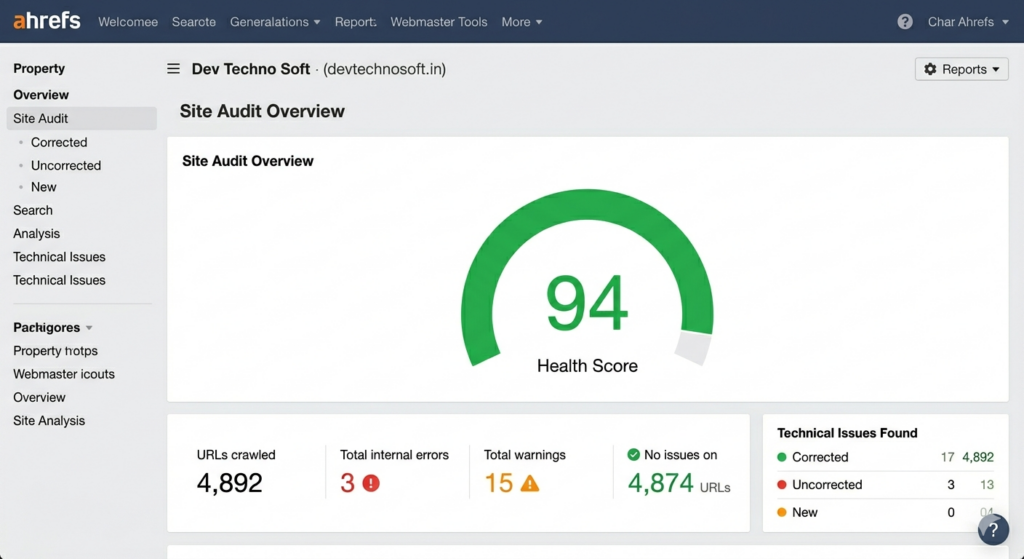
- Comprehensive Site Audits: AWT automatically crawls your site and provides a “Health Score.” It flags technical issues like broken links (404s), missing H1 tags, and slow-loading pages.
- Organic Keyword Tracking: View a broader scope of the keywords your domain ranks for across different global databases.
Expert Actionable Tip
Take a screenshot of the AWT “Site Health Score” at the beginning of an SEO campaign. Include it in your monthly reports alongside the updated score to visually demonstrate how your technical SEO fixes are improving the structural integrity of the website.
5. Screaming Frog SEO Spider (Free Version)
For technical SEO reporting, nothing beats Screaming Frog SEO Spider. It is a downloadable software that mimics how search engine bots crawl a website. The free version allows you to crawl up to 500 URLs, which is more than enough for small to medium-sized local business websites or niche blogs.
Why It Is Essential for SEO Reporting
When you are onboarding a new client or doing a quarterly review, you need to report on the invisible technical foundation of the site.
- Redirect Chains: Identify and report on messy 301 redirect chains that are diluting link equity.
- Meta Data Analysis: Quickly export a list of all pages missing meta descriptions, title tags, or alt text.
- Canonicalization Errors: Ensure that duplicate content issues are properly managed.
Expert Actionable Tip
Run a crawl and export the “Response Codes” report. Highlight the 4xx (Client Error) pages in red on a spreadsheet. Including this in your SEO report provides a highly actionable to-do list for web developers to fix immediate user-experience roadblocks.
How to Combine These Tools for the Ultimate SEO Report
Using these tools in isolation is helpful, but the magic happens when you stack them together to create a unified narrative for your clients at Dev Techno Soft. Here is a proven workflow:
- The Data Gathering Phase: * Use Screaming Frog and Ahrefs Webmaster Tools to run a technical health check.
- Gather traffic and conversion data from GA4.
- Pull keyword and visibility data from GSC.
- The Assembly Phase: * Open Looker Studio. Connect your GSC and GA4 accounts.
- Create dedicated pages in your dashboard: Page 1 (Executive Summary & KPIs), Page 2 (Traffic & Conversions), Page 3 (Keyword Performance), Page 4 (Technical Health & Backlinks).
- The Presentation Phase: * Manually add text boxes in Looker Studio to provide context. Data without context is confusing. Explain why traffic dipped (e.g., a Google algorithm update or seasonality) or why conversions spiked.
Best Practices for Client-Facing SEO Reports
Even with the best free tools, your report will fail if it is not tailored to your audience. Keep these golden rules in mind:
- Speak Their Language: Avoid overwhelming clients with SEO jargon. Instead of saying “We fixed 45 canonicalization errors,” say “We improved the site’s code so Google can index your core services faster.”
- Focus on the KPIs that Matter: Don’t bloat the report with irrelevant metrics. If the client’s goal is lead generation, put GA4 form-fill conversions front and center.
- Always Include Next Steps: A good report looks backward, but a great report looks forward. Conclude every SEO report with a clear bulleted list of the actions your team at Dev Techno Soft will take in the upcoming month based on the data.
Conclusion
Building high-quality, actionable SEO reports doesn’t require a massive monthly software budget. By mastering Google Search Console, GA4, Looker Studio, Ahrefs Webmaster Tools, and Screaming Frog, you can provide top-tier insights that rival any expensive enterprise platform.Start integrating these five free SEO tools into your workflow today, and transform the way you showcase digital growth. If you are looking to elevate your digital presence further, the experts at Dev Techno Soft are always here to help you turn data into scalable business success.