


4 May, 2026
WordPress vs Shopify 2026: The Ultimate SEO Showdown – 10 Powerful Insights for Better Rankings
Introduction to WordPress vs Shopify
The comparison between WordPress and Shopify in 2026 is no longer a basic “which is easier” discussion—it’s a strategic decision that directly impacts organic visibility, scalability, and long-term digital growth. With search engines becoming more sophisticated—prioritizing user experience, intent matching, and technical performance—your choice of platform plays a foundational role in how effectively your site competes in SERPs.
At its core, this debate—WordPress vs Shopify 2026: The Ultimate SEO Showdown—is about control versus convenience. WordPress, as an open-source CMS, offers unmatched flexibility and granular SEO control. Shopify, on the other hand, provides a streamlined, hosted environment optimized for eCommerce performance with minimal technical overhead. The right choice depends on how deeply you want to engage with SEO infrastructure versus how quickly you want to deploy and scale.
From an SEO standpoint, 2026 has introduced stricter benchmarks. Google’s algorithm now heavily weighs factors tied to Core Web Vitals—including loading speed, interactivity, and visual stability. These aren’t optional optimizations anymore; they’re ranking prerequisites. WordPress gives developers full access to optimize these metrics through custom themes, caching layers, and hosting choices. Shopify simplifies this by handling performance optimization at the platform level, but with limited room for deep customization.
Another critical dimension is search intent alignment and content architecture. WordPress excels in content-heavy SEO strategies—blogs, pillar pages, and topical authority building—thanks to plugins like Yoast SEO or Rank Math. These tools allow advanced schema implementation, keyword optimization, and internal linking strategies. Shopify, while improving its blogging capabilities, is still fundamentally product-centric, which can restrict content-driven SEO campaigns unless supplemented with external strategies.
Technical SEO also varies significantly between the two. WordPress allows full control over URL structures, canonical tags, robots.txt, and XML sitemaps. Shopify, while covering the basics, enforces a more rigid URL hierarchy (e.g., /products/, /collections/), which can limit advanced SEO structuring. For seasoned SEO professionals, this limitation can be a decisive factor when building highly optimized site architectures.
Then comes scalability and ecosystem strength. WordPress powers a massive portion of the web and benefits from a vast plugin ecosystem, developer community, and customization potential. Shopify, however, has built a tightly integrated app ecosystem focused on eCommerce efficiency—inventory, payments, and conversion optimization—which indirectly supports SEO through better UX and lower bounce rates.
Ultimately, the decision between WordPress and Shopify in 2026 isn’t about which platform is “better”—it’s about which aligns with your SEO strategy and operational capabilities:
- If your goal is content dominance, technical SEO precision, and full control, WordPress is the stronger contender.
- If your focus is fast deployment, stable performance, and conversion-driven eCommerce, Shopify offers a more efficient path.
This guide by Dev Techno Soft is designed to go beyond surface-level comparisons and provide you with a practical, SEO-first framework for evaluating both platforms—covering flexibility, performance, indexing behaviour, and real-world ranking potential.
Understanding SEO in 2026
SEO in 2026 operates on a fundamentally different layer than it did even a few years ago. The algorithm is no longer just parsing keywords—it’s interpreting intent, evaluating experience signals, and predicting user satisfaction. Search engines like Google now function more like answer engines powered by advanced AI models rather than simple indexing systems.
Evolution of SEO Trends
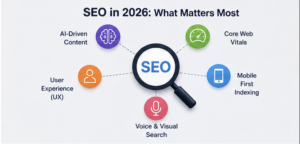
A convergence of AI, behavioural data, and performance engineering shapes the modern SEO landscape. One of the most defining shifts is the dominance of user-centric ranking signals. Metrics tied to Core Web Vitals—such as Largest Contentful Paint (LCP), First Input Delay (FID), and Cumulative Layout Shift (CLS)—have moved from “nice-to-have” optimisations to critical ranking determinants. If your site fails these benchmarks, it doesn’t matter how strong your content is—you’re already at a disadvantage.
User experience (UX) has become algorithmically measurable. Elements like navigation clarity, mobile responsiveness, dwell time, and interaction fluidity now feed directly into ranking models. Google’s systems can infer whether users find your content helpful, whether they bounce quickly, or whether they engage deeply.
Another major evolution is AI-driven content relevance. With advancements in natural language processing, search engines understand context, synonyms, and semantic relationships far more effectively. This means content must be built around topical authority rather than isolated keywords. The focus has shifted toward building comprehensive content clusters that satisfy entire search journeys—not just single queries.
Voice and visual search have also matured significantly. Queries are now more conversational and intent-rich, often framed as questions or commands. Visual search, powered by tools like Google Lens, allows users to search using images instead of text. This expands SEO beyond written content into image optimization, alt-text strategy, and structured metadata.
As a result, outdated practices like keyword stuffing, thin content, and backlink manipulation have lost effectiveness. Instead, structured data (schema markup), fast-loading assets, and mobile-first design are essential. Schema, in particular, helps search engines interpret your content more precisely—enabling rich results, featured snippets, and enhanced SERP visibility.
Importance of Platform Choice
Your platform—whether it’s a CMS like WordPress or an eCommerce system like Shopify—is not just a technical foundation; it’s an SEO enabler or constraint.
First, it dictates how efficiently you can optimize content. A flexible platform allows precise control over meta tags, heading structures, internal linking, and schema implementation. Without this control, even high-quality content may underperform due to technical limitations.
Second, platform architecture directly affects site speed and performance. Hosting infrastructure, code efficiency, and resource handling all influence loading times and responsiveness. Since performance metrics are tied to rankings, your platform’s underlying technology becomes a competitive factor.
Third, technical SEO capabilities vary widely between platforms. This includes control over URL structures, canonical tags, redirects, XML sitemaps, robots directives, and crawl management. Advanced SEO strategies—such as managing crawl budgets or optimizing indexation—require a platform that doesn’t impose rigid constraints.
In practical terms, your CMS or eCommerce platform is your SEO infrastructure. It determines how well you can implement modern optimization strategies, adapt to algorithm updates, and scale your visibility over time. A poor platform choice creates friction at every level—content, performance, and technical execution—while the right one compounds your SEO efforts and accelerates growth.
Overview of the WordPress Platform
WordPress has evolved from a simple blogging tool into a full-scale content management framework that underpins a significant portion of the modern web. Powering over 40% of all websites globally, its dominance is not accidental—it’s the result of architectural flexibility, extensibility, and deep control over both frontend and backend environments.
Key Features of WordPress
The defining advantage of WordPress is its open-source architecture. Unlike closed ecosystems, WordPress allows complete access to its core codebase, enabling developers to modify, extend, and optimize every layer of the website. This level of control is particularly valuable in SEO, where even minor technical adjustments can influence crawlability and ranking performance.
Its ecosystem is another major strength. With thousands of themes and plugins available, WordPress can be adapted to virtually any use case—from simple blogs to enterprise-level platforms. Themes control design and UX, while plugins extend functionality, including caching, security, schema markup, and advanced SEO tooling.
Equally important is its scalability. WordPress supports everything from lightweight personal blogs to high-traffic content hubs and eCommerce stores (via integrations like WooCommerce). This makes it suitable for bloggers, startups, SMEs, and even large-scale enterprises that require custom workflows and integrations.
From a development standpoint, WordPress provides full control over code—HTML, CSS, JavaScript, PHP—which allows precise optimization of performance, structure, and user experience. This is a critical differentiator compared to hosted platforms with restricted environments.
SEO Capabilities of WordPress
WordPress is widely regarded as one of the most SEO-capable platforms available—but this strength is conditional. It becomes an “SEO powerhouse” only when properly configured.
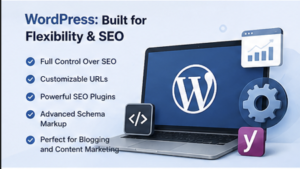
First, it offers complete control over on-page SEO elements. You can customize URLs (permalinks), meta titles, meta descriptions, heading structures, canonical tags, and robots directives without restriction. This level of granularity is essential for aligning pages with search intent and ensuring proper indexation.
Second, its plugin ecosystem significantly enhances SEO execution. Tools like Yoast SEO and Rank Math provide advanced capabilities such as keyword optimization, readability analysis, XML sitemap generation, schema markup integration, and internal linking suggestions. These plugins effectively bridge the gap between technical SEO and content strategy.
Third, WordPress integrates seamlessly with analytics and search tools. Platforms like Google Analytics and Google Search Console can be connected with minimal friction, enabling detailed tracking of user behavior, traffic sources, indexing status, and performance metrics. This data is essential for iterative SEO improvement.
Additionally, WordPress supports advanced technical SEO implementations. You can optimize site speed using caching plugins, CDN integrations, and image compression tools. You can also implement structured data manually or via plugins, manage redirects efficiently, and fine-tune crawl behavior—all of which contribute to stronger search engine visibility.
In essence, WordPress does not impose SEO limitations—it provides a framework where your expertise determines the outcome. For users with the right technical understanding or access to skilled developers, it offers unmatched SEO control and scalability.

Overview of the Shopify Platform
Shopify is engineered as a fully hosted, SaaS-based eCommerce ecosystem. Unlike open-source platforms, Shopify abstracts away infrastructure complexity—hosting, security, updates, and compliance are all managed within its controlled environment. This makes it operationally efficient, particularly for businesses that prioritize speed-to-market over deep technical customization.
Key Features of Shopify
The most defining characteristic of Shopify is its “out-of-the-box” readiness. Users can launch a fully functional online store without dealing with server configuration, database management, or code deployment. Built-in hosting ensures consistent uptime and optimized performance without requiring third-party providers.
Its integrated payment infrastructure—Shopify Payments along with multiple third-party gateways—streamlines transactions while maintaining high security standards (PCI compliance). This is critical not only for conversions but also for trust signals that indirectly influence SEO through user behavior metrics.
The drag-and-drop store builder simplifies UI/UX creation. Even non-technical users can design storefronts, manage products, and configure checkout flows. Combined with a curated app ecosystem, Shopify enables rapid deployment of features like inventory management, email automation, and conversion tracking.
From a business standpoint, Shopify is optimized for entrepreneurs and D2C brands that want to launch quickly, validate products, and scale operations without investing heavily in development resources.
SEO Capabilities of Shopify
Shopify provides a solid baseline for SEO, particularly for eCommerce-focused websites, but operates within defined constraints.
Its site architecture is inherently clean and structured, which supports efficient crawling and indexing. Automatic XML sitemap generation ensures that search engines can discover and index pages without manual intervention. Additionally, most Shopify themes are mobile-responsive, aligning with mobile-first indexing standards enforced by Google.
However, Shopify’s SEO limitations become apparent in advanced scenarios. URL structures are partially locked (e.g., /products/, /collections/), which restricts granular optimization. Access to deeper technical SEO elements—such as full control over robots.txt, canonical logic, and server-level configurations—is limited compared to open-source systems.
While basic on-page SEO (meta tags, alt text, headings) is manageable, advanced customization often requires apps or workarounds. This makes Shopify efficient for standard SEO implementation but less flexible for complex strategies.
WordPress vs Shopify 2026: Core Differences
Flexibility and Customization
From an SEO engineering perspective, flexibility directly correlates with optimization potential.
With WordPress, you have unrestricted access to backend code, database structure, and server-level configurations. This enables advanced implementations—custom schema, dynamic rendering, headless CMS architectures, and performance tuning at a granular level.
Shopify, by contrast, operates within a controlled SaaS framework. While it allows front-end customization through Liquid templates, backend access is restricted. This ensures stability but limits deep technical SEO interventions.
The implication is straightforward: if your SEO strategy requires precision, experimentation, and custom architecture, WordPress provides the necessary control.
Ease of Use
Ease of use directly impacts execution speed and operational efficiency.
Shopify is designed for accessibility. The onboarding process is streamlined—hosting, themes, and essential configurations are pre-integrated. A user with minimal technical knowledge can launch a store within hours.
WordPress, on the other hand, involves a more complex setup cycle. Users must manage hosting, install the CMS, configure themes, and optimize plugins. While this adds flexibility, it also introduces a learning curve and potential setup friction.
From a resource allocation standpoint, Shopify reduces technical overhead, while WordPress demands either technical expertise or developer support.
Cost Comparison (Strategic View)
Cost in 2026 is not just about upfront investment—it’s about total cost of ownership (TCO) over time.
WordPress operates on a modular cost structure. The core platform is free, but expenses arise from hosting, premium themes, plugins, and development. This variability allows cost optimization but requires careful resource planning.
Shopify follows a subscription-based model with predictable monthly pricing. Hosting and security are included, but additional functionality often depends on paid apps, which can increase long-term costs.
| Feature | WordPress | Shopify |
|---|---|---|
| Setup Cost | Low (variable) | Fixed monthly subscription |
| Hosting | External (separate cost) | Included |
| Plugins/Apps | Mix of free and paid | Predominantly paid |
From a long-term SEO and scalability perspective, WordPress can become more cost-efficient, especially when leveraging open-source tools and avoiding recurring app fees.
Strategic Takeaway
The distinction between WordPress and Shopify in 2026 is not just functional—it’s philosophical. WordPress is an open, developer-centric ecosystem optimized for control and extensibility. Shopify is a managed, business-centric platform optimized for speed and simplicity.
Your decision should align with your SEO maturity level, technical resources, and growth strategy.
WordPress vs Shopify (2026 Deep Analysis)
On-Page SEO Control
On-page SEO remains the foundation of search visibility, and in 2026, it’s deeply tied to semantic structure, intent alignment, and content hierarchy.
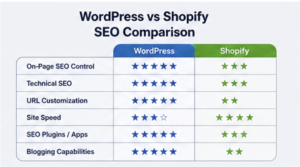
WordPress provides unrestricted control over all critical on-page elements. You can fine-tune meta titles, meta descriptions, heading structures (H1–H6), URL slugs, canonical tags, and internal linking architecture without constraints. This level of control allows precise keyword targeting, better SERP snippet optimization, and improved crawl understanding.
With plugins like Yoast SEO, you can operationalize on-page SEO at scale—optimizing readability, keyword density, schema integration, and content structure in real time.
Shopify, while offering basic on-page controls, operates within predefined limits. You can edit titles, descriptions, and alt text, but URL structures and deeper HTML modifications are partially restricted. This becomes a bottleneck when implementing advanced strategies such as silo structuring or custom canonicalization.
Technical SEO Features
Technical SEO is where the gap between the two platforms becomes more pronounced. In 2026, search engines rely heavily on structured data, crawl efficiency, and indexation control.
WordPress enables advanced technical SEO implementation. You can deploy custom schema markup (JSON-LD), edit robots.txt directly, manage XML sitemaps dynamically, and implement complex redirect rules. This is critical for large websites where crawl budget optimization and index management directly impact rankings.
Additionally, WordPress allows integration with server-level configurations, enabling advanced caching strategies, CDN setups, and performance tuning aligned with Core Web Vitals requirements.
Shopify, in contrast, abstracts most technical SEO elements. It automatically generates sitemaps and handles canonical tags, which simplifies setup but limits flexibility. Direct access to robots.txt and deeper indexing controls is restricted, making it harder to execute advanced technical SEO strategies or troubleshoot crawl issues at scale.
Speed and Performance
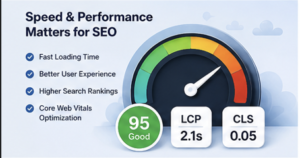
Performance optimization is a critical ranking factor in 2026, heavily influenced by Core Web Vitals and user interaction metrics.
Shopify’s primary advantage lies in its managed infrastructure. Hosting is optimized at the platform level, ensuring consistent loading speeds, built-in CDN usage, and minimal configuration requirements. This reduces performance variability and ensures that even non-technical users can meet baseline speed standards.
WordPress performance, however, is variable by design. It depends on hosting quality, theme efficiency, plugin load, and optimization practices. A poorly configured WordPress site can be slow and inefficient—but a well-optimized setup can outperform Shopify significantly in speed benchmarks.
This introduces a trade-off: Shopify offers predictable performance with minimal effort, while WordPress offers higher performance potential with proper optimization.
Strategic Interpretation
From an SEO engineering perspective:
- WordPress is a high-control environment—ideal for advanced SEO strategies, content scaling, and technical customization.
- Shopify is a high-efficiency environment—ideal for stable performance, rapid deployment, and operational simplicity.
The decision ultimately hinges on whether you prioritize control (WordPress) or consistency (Shopify) in your SEO execution model.
E-commerce SEO: Which Platform Performs Better in 2026?
When evaluating eCommerce SEO performance, the comparison between WordPress (via WooCommerce) and Shopify becomes highly nuanced. It’s not just about rankings—it’s about how SEO integrates with product visibility, user behavior, and conversion efficiency across the entire funnel.
Product Page Optimization
Product pages are the primary ranking assets for eCommerce SEO, and their structure directly influences both visibility and conversions.
With WordPress + WooCommerce, you gain full control over every element of the product page. This includes URL structure, schema markup, content blocks, FAQs, reviews, and internal linking. This flexibility enables aggressive long-tail keyword targeting—capturing highly specific, intent-driven queries that often convert better and face less competition.
You can also create content-rich product pages with buying guides, comparison tables, and semantic keyword clusters—turning each product page into a hybrid landing page optimized for both users and search engines.
Shopify, in contrast, standardizes product page layouts. While this ensures consistency and usability, it limits deep customization. You can optimize titles, descriptions, and images, but creating highly differentiated, SEO-heavy product pages often requires apps or custom development.
Checkout and Conversion SEO
SEO doesn’t end at rankings—it extends into conversion efficiency. This is where Shopify demonstrates a strong edge.
Shopify’s checkout process is highly optimized, streamlined, and tested across millions of stores. It minimizes friction, supports multiple payment options, and ensures fast load times. These factors improve conversion rates, reduce cart abandonment, and send positive engagement signals (lower bounce rates, higher dwell time) back to search engines.
WordPress (WooCommerce) offers customizable checkout flows, but achieving the same level of optimization typically requires multiple plugins, performance tuning, and UX testing. Without proper configuration, checkout friction can negatively impact conversions.
Plugins vs Apps: SEO Tools Comparison
The tooling ecosystem directly impacts how efficiently you can execute SEO strategies.
WordPress offers a highly mature plugin ecosystem. Tools like Yoast SEO, Rank Math, and All in One SEO provide advanced capabilities—schema automation, keyword optimization, internal linking suggestions, redirection management, and detailed SEO audits.
These plugins are deeply integrated into the CMS, giving you granular control over both on-page and technical SEO layers.
Shopify’s app ecosystem includes tools like SEO Manager and Plug in SEO, which cover core optimization needs. However, they generally operate within Shopify’s platform constraints, limiting advanced customization and technical control.
Security and SEO Impact
Security is an indirect but critical SEO factor. A compromised site can lead to deindexing, ranking drops, or user trust issues.
Shopify handles security at the platform level. SSL certificates are included by default, updates are automatic, and infrastructure is continuously monitored. This reduces the risk of vulnerabilities and ensures consistent site integrity.
WordPress requires proactive security management. Users must implement security plugins, manage updates, and configure protections manually. While this adds responsibility, it also allows customization for enterprise-grade security setups.
Mobile Optimization and Core Web Vitals
Mobile-first indexing is now standard, and performance metrics tied to Core Web Vitals directly influence rankings.
Shopify themes are pre-optimized for mobile responsiveness and performance. This ensures consistent compliance with Core Web Vitals benchmarks without requiring deep technical intervention.
WordPress, however, requires manual optimization. Theme quality, plugin load, hosting, and caching strategies all influence mobile performance. A well-optimized WordPress site can outperform Shopify—but achieving that requires technical expertise.
Blogging Capabilities for SEO
Content marketing remains a dominant SEO driver, especially for organic traffic acquisition beyond product searches.
WordPress is widely recognized as the most powerful blogging platform. It supports advanced content structuring, category hierarchies, internal linking strategies, and content clustering. This makes it ideal for building topical authority and ranking for informational keywords at scale.
Shopify includes basic blogging functionality, but it lacks the depth required for sophisticated content marketing strategies. Managing large content ecosystems or implementing pillar-cluster models is significantly more efficient on WordPress.
Strategic Conclusion
From an eCommerce SEO perspective:
- WordPress (WooCommerce) is optimized for visibility and control—ideal for brands focusing on organic traffic, content marketing, and advanced SEO execution.
- Shopify is optimized for efficiency and conversion—ideal for businesses prioritizing fast setup, stable performance, and revenue generation.
The optimal choice depends on whether your growth strategy is traffic-first (WordPress) or conversion-first (Shopify).
Dev Techno Soft Insights on Platform Choice
From a strategic SEO consulting standpoint, platform selection is not a superficial decision—it defines your long-term digital growth trajectory. At Dev Techno Soft , the recommendation framework is based on aligning platform capabilities with business objectives, resource availability, and SEO maturity.
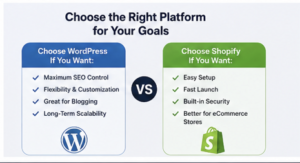
For content-first businesses—such as blogs, service websites, SaaS platforms, and authority sites—WordPress is the preferred choice. Its open architecture allows deep optimization across content, technical SEO, and site structure. This is critical when your growth depends on organic traffic, keyword expansion, and topical authority.
For commerce-first businesses—especially startups and D2C brands looking for rapid deployment—Shopify provides a more efficient pathway. It minimizes technical overhead while delivering stable performance and strong conversion infrastructure.
The key distinction lies in control versus convenience. If SEO is a core acquisition channel, WordPress provides the scalability and precision required to compete in increasingly complex SERPs. If operational simplicity and speed-to-market are higher priorities, Shopify delivers faster execution with fewer dependencies.
Pros and Cons: Strategic Breakdown
| Platform | Pros | Cons |
|---|---|---|
| WordPress | Full SEO control, scalable architecture, flexible customization | Requires setup, maintenance, expertise |
| Shopify | Easy to use, fast deployment, secure infrastructure | SEO flexibility, platform constraints |
This comparison should be interpreted through a total cost-benefit lens. WordPress demands more upfront effort but compounds value over time through SEO leverage. Shopify reduces complexity but imposes structural limitations that may impact advanced growth strategies.
Conclusion: Final SEO Verdict for 2026
The WordPress vs Shopify 2026: The Ultimate SEO Showdown is not about identifying a universal winner—it’s about strategic alignment.
Choose WordPress if your objective is maximum SEO leverage, full technical control, and long-term scalability. It is the platform of choice for businesses that view organic search as a primary growth engine and are willing to invest in optimization.
Choose Shopify if your priority is speed, operational simplicity, and conversion efficiency. It is ideal for businesses that want to launch quickly and focus on sales without managing technical complexity.
From a purely SEO-centric perspective, WordPress maintains a structural advantage due to its flexibility and depth. However, Shopify continues to evolve, narrowing the gap and remaining a highly competitive solution for eCommerce-focused operations.
The correct decision ultimately depends on your strategic priorities: control and scalability vs speed and simplicity.
Frequently Asked Questions (SEO Perspective)
1. Which is better for SEO: WordPress or Shopify?
WordPress consistently outperforms in SEO due to unrestricted control over on-page, technical, and structural optimization. It allows precise execution of advanced strategies that are difficult to implement in closed environments.
2. Is Shopify good for beginners?
Yes. Shopify is designed for non-technical users. Its managed ecosystem eliminates the need for hosting setup, security management, and complex configurations, enabling faster onboarding.
3. Can Shopify rank on Google?
Absolutely. Shopify stores can rank effectively on Google, especially for product-based queries. However, limitations in URL structure and technical customization can restrict performance in highly competitive niches.
4. Do I need coding knowledge for WordPress?
Not mandatory, but beneficial. Basic websites can be built without coding, but advanced SEO, performance tuning, and custom functionality often require development expertise.
5. Which platform is more cost-effective in 2026?
WordPress can be more economical over time, particularly for content-heavy sites, as it avoids recurring app fees. Shopify’s subscription and app ecosystem can increase long-term operational costs.
6. What does Dev Techno Soft recommend?
The recommendation is use-case driven: WordPress for SEO-intensive, content-led strategies; Shopify for streamlined eCommerce operations with minimal technical friction.